A real board an AI built with this skill.Open the real board
What you'll get
- Layout
- SWOT
- Font
- Sans
Instructions
What your AI reads before it draws a board with this skill.
SKILL.md
- name
- swot-analysis
- description
- Use when someone wants a SWOT analysis of a company, product, team or plan: four pastel quadrants for strengths, weaknesses, opportunities and threats, each point on its own sticky note.
SWOT analysis
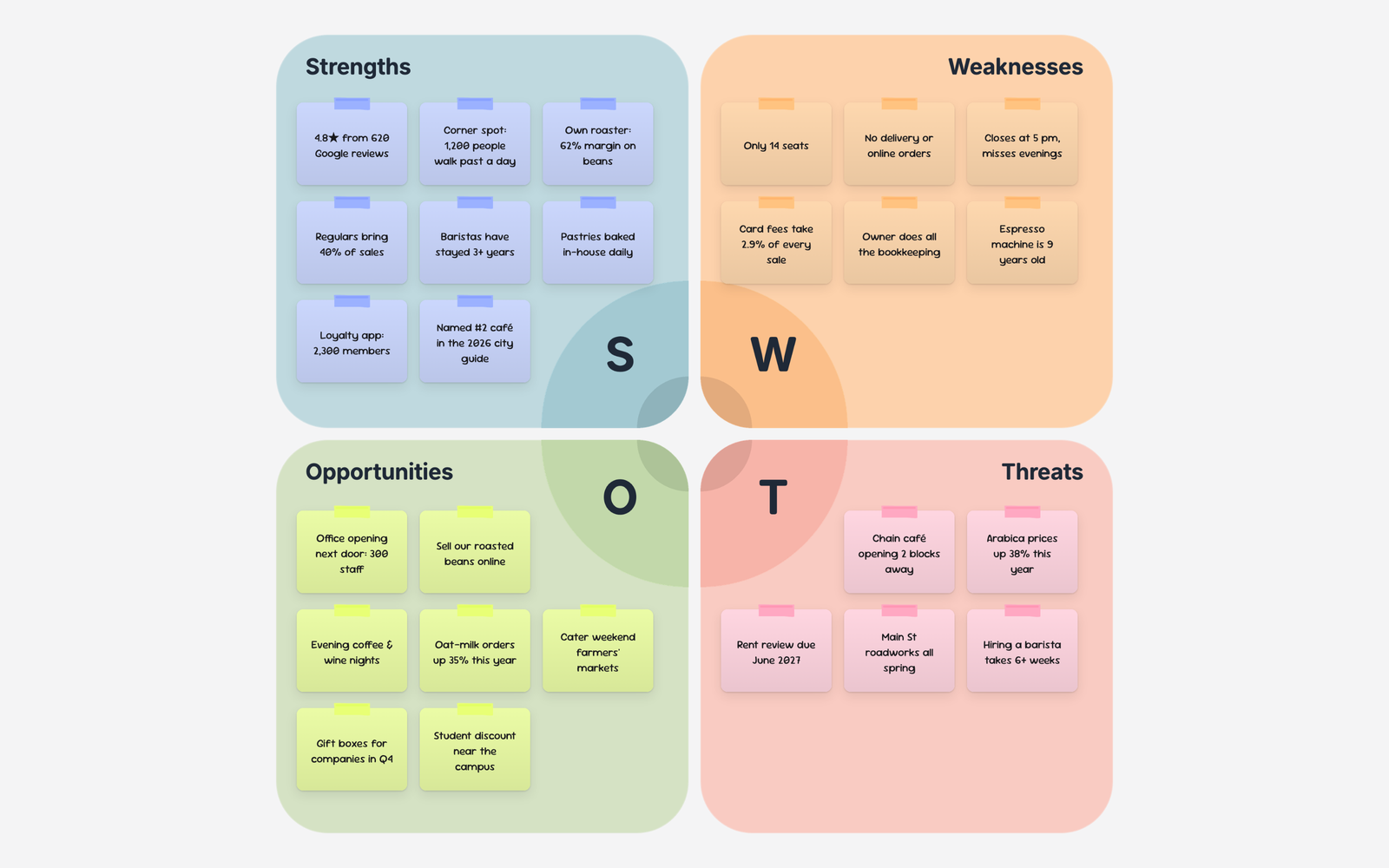
Build a SWOT board: four soft-colored quadrants with rounded corners, the title in each outer corner, a big S, W, O or T on two-tone quarter circles where the quadrants meet, and every point on its own sticky note. No frame and no board title: the quadrants sit straight on the board.
Content
- Strengths and weaknesses are inside the subject (team, product, money, location); opportunities and threats come from outside (market, competitors, prices, rules).
- Each point is a short concrete line under 40 characters with a number, name or date where you can: "4.8★ from 620 reviews", not "Good reviews". Never placeholders.
- Any number of points per quadrant: the layout grows to fit them. Past about 12 in one quadrant, merge the weakest ones.
- If you know too little about the subject, ask for the facts before drawing.
Size
Pick a top-left corner (X, Y) clear of anything already on the board. Quadrants are 560 wide with a 16 gap; their height grows with the notes they hold.
- rows(n) = the larger of 2 and ceil((n + 1) / 3). Each quadrant holds 3 x rows - 1 notes.
- The top pair (S, W) uses top = the larger of rows(S) and rows(W); the bottom pair (O, T) uses bottom the same way, so both quadrants in a row stay the same height.
- Height = 400 + (rows - 2) x 134. So 5 notes fit in 400, 8 in 534, 11 in 668.
- Positions: S at (X, Y), W at (X + 576, Y), O at (X, Y + topHeight + 16), T at (X + 576, Y + topHeight + 16).
Parts of each quadrant (x, y is the quadrant's corner, h its height)
| Fill | Sticky fillColor | Title | Corner image at | Letter at | |
|---|---|---|---|---|---|
| S | #bfd9df | blue | left, x + 40 | x + 360, y + h - 200 | x + 432, y + h - 128 |
| W | #fdd2ac | orange | right, x + 220 | x, y + h - 200 | x + 64, y + h - 128 |
| O | #d5e2c4 | lime | left, x + 40 | x + 360, y | x + 432, y + 50 |
| T | #f9cbc2 | pink | right, x + 220 | x, y | x + 64, y + 50 |
- Quadrant: a rect 560 x h, cornerRadius 70, strokeWidth 0, strokeColor equal to its fill.
- Corner image: an image item 200 x 200 from https://cdn.public.drawdy.io/images/skills/seed/swot-analysis/assets/s.png (w.png, o.png, t.png for the others): the two quarter circles, already cut to the quadrant's rounded corner.
- Letter: a text item with the single letter, fontSize 64, bold, fontFamily sans, width 70, textAlign center.
- Title: a text item, fontSize 30, bold, fontFamily sans, width 300, at y + 30, textAlign left or right as the table says.
- Sticky notes: shape items with componentType sticky-note, 150 x 112, fontSize 15, the point as the note's text, no rotation. Columns at x + 28, x + 195 and x + 362. Rows every 134 starting at y + 92 for S and W, y + 96 for O and T. One slot sits under the corner circle, so skip it: S skips the last row's third column, W the last row's first column, O the first row's third column, T the first row's first column. Fill the remaining slots in reading order.
Steps
- Add everything in one add_elements call, in this order so the layers stack right: the four quadrant rects, the corner images, the letters, the titles, the sticky notes. Group each quadrant's rect, image, letter and title together; leave the sticky notes ungrouped so people can move them one by one.
- Do not set text colors: they follow the theme and stay readable on the pastel fills.
- Run check_board on the SWOT's area (render both). check_board can flag blue sticky notes as low contrast; their text renders dark and readable, so leave them.
- To add points later, place the note in the next free slot; if the quadrant is full, grow both quadrants in that row by 134 and move the pair below, its corner images and letters down with dy.